Hazards and Risk Controls
1. Work on the ground or on a solid construction
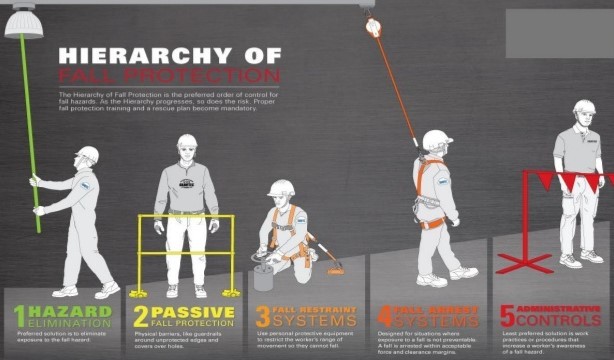
If you don’t have to work at heights, don’t. Working from the ground is always the safest option.
2. Use a fall-prevention device
If you have to work from a height, you need to manage the risk of a fall. A fall-prevention device is best because it will prevent your workers from falling. Examples include temporary work platforms, guardrails and scaffolding. All help to keep you safer when working at heights.
3. Use a work-positioning
When it is not possible to use a fall-prevention device, a work-positioning system is your next best option. A work-positioning system either prevents a fall hazard being reached e.g. restraint system or enables a person to work supported in tension in a way that prevents the person from falling e.g. industrial rope access.
4. Use a fall-arrest system
A fall-arrest system is only used when it is not possible to use either a fall-prevention device or a work-positioning system. A fall-arrest system may not prevent a fall, however it stops a person who has fallen and reduces the impact of the fall and can reduce injuries in a fall. Examples include industrial safety nets, catch platforms or harness-based fall- arrest harnesses used with lifelines or individual anchors.
If you use a fall arrest system, you must have emergency and rescue procedures in place and test them to ensure they are effective.
Fall Prevention
The Organisation must ensure, as far as reasonably practicable, that workers and other persons are not exposed to the risk of a fall from one level to another. The organisation must:
1 – ensure, so far as is reasonably practicable, that any work involving the risk of a fall is carried out on the ground or on a solid construction
2 – provide safe means of access to and exit from the workplace, and
3 – minimise the risk of falls so far as is reasonably practicable by providing a fall prevention device, work positioning system or a fall arrest system.
This includes circumstances in which the worker or other person is:
– in or on plant or a structure that is at an elevated level
– in or on plant that is being used to gain access to an elevated level
– in the vicinity of an opening through which a person could fall
– in the vicinity of an edge over which a person could fall
– on or in the vicinity of a surface through which a person could fall, or
– on or near the vicinity of a slippery, sloping or unstable surface.
To manage the risks associated with a fall the Organisation must refer to the Work Health & Safety Regulation 2017 and the Code of Practice How to Prevent Falls at Workplaces.
The Organisation must adopt the following approach to managing risk of a person falling from one level to another:
– identifying hazards that may cause injury
– if necessary, assessing the risks associated with these hazards
– implementing risk control measures, and
– reviewing risk control measures to ensure they are effective.
Workers and the WHSR where appointed will be consulted in the development of controls to manage the risk of a fall.
Identifying Fall Hazards
Identifying Fall Hazards
The Organisation must identify all physical locations and tasks that could cause injury due to a fall. This includes access to the areas where work is to be carried out. Tasks that need particular attention are those carried out:
– on any structure or plant being constructed or installed, demolished or dismantled, inspected, tested, repaired or cleaned
– on a fragile surface (for example, cement sheeting roofs, rusty metal roofs, fibreglass sheeting roofs and skylights)
– on a potentially unstable surface (for example, areas where there is potential for ground collapse)
– using equipment to work at the elevated level (for example, when – using elevating work platforms or portable ladders)
– on a sloping or slippery surface where it is difficult for people to maintain their balance (for example, on glazed tiles)
– near an unprotected open edge (for example, near incomplete stairwells), and
– near a hole, shaft or pit into which a worker could fall (for example, trenches, lift shafts or service pits).
Fall Protection
Workplace Inspection