An arc flash is a release of electrical energy that causes an explosion which can reach temperatures of up to 20,000 degrees Celsius. An arc flash usually occurs in large switchboards but can also occur in smaller switchboards, electricity supply pillars or large electrical equipment. An arc flash or fault happens when electric current flows through air gaps between conductors – essentially, it is a short circuit. Arc flashes often occur when racking in a breaker, performing switching, Insulation failure, and accidents caused by touching a test probe to the wrong surface or slipped (non-insulated) tools.
In its most basic form, an arc is made up of four elements:
- Thermal Energy (heat),
- Acoustical Energy (sound),
- Presssue Wave,
- Debris.
Each of these elements can cause serious injury or death to a person.
Common causes of arc flash include:
- unsafe work practices and procedures
- foreign materials
- breakdown of busbar insulation
- electrical equipment failure such as a switch, circuit breaker or loose cables
- contacting energised equipment with uninsulated tools
- using test equipment not designed or rated for the job.
AS/NZS 4836:2011 specifies Arc Flash PPE that must be used in certain situations. The Arc Flash PPE specified is of American Standards rating (NFPA 70-E). The American standard classifies garments by a rating known as cal/cm2. This is calories, per square centimetre. Calorie is a measure of energy (or heat), required to heat 1L of water by 1°C. The higher a cal/cm2 rating a garment will have, the more heat and energy it can protect the wearer from.
AS/NZS 4836:2011 specifies certain cal/cm2 (or simply ‘cal’) ratings certain pieces of PPE are now required to have.
Higher risk tasks, require higher rating pieces of PPE.
The table below is based on table 9.1 from AS/NZS 4836:2011 and shows the new Arc Flash requirements for PPE
| Personal Protective Equipment (PPE) | Requirements to AS/NZS 4836:2011 | Clarification |
| Eye protection | No metal, complying with AS/NZS1337 and selected in accordance with AS/NZS 1336. | Heat resistant, no metal |
| Face Shield | Certified to 10cam/cm2 | Tested to 10cal |
| Arc Flash suit and hood | Certified to 40cam/cm2 | Tested to 40cal |
| Insulating gloves | AS2225 or Equivalent, rated to appropriate voltage, air tested before use. | IEC, ASTM and EN gloves acceptable |
| Flame-resistant (FR) gloves | Gloves made from leather or other non-melting heat-resistance material | Complying with AS/NZS2161.4 |
| Protective Clothing | Flame-resistant, full body clothing with no metal. | Cotton not suitable. Must be FR rated and tested fabric. |
Electrical safety laws prohibit work on energised electrical equipment unless:
- it is necessary in the interests of health and safety that the electrical work is carried out while the equipment is energised (for example, on life-saving equipment)
- it is necessary that the electrical equipment is energised in order for work on it to be carried out properly
- it is necessary for the purposes of testing to ensure the equipment is energised
- there is no reasonable alternative means of carrying out the work.
If workers are required to work on or near electrical equipment, take all reasonably practical measures to protect workers from arc flash through hazard elimination and risk reduction.
The Limited Boundary Approach
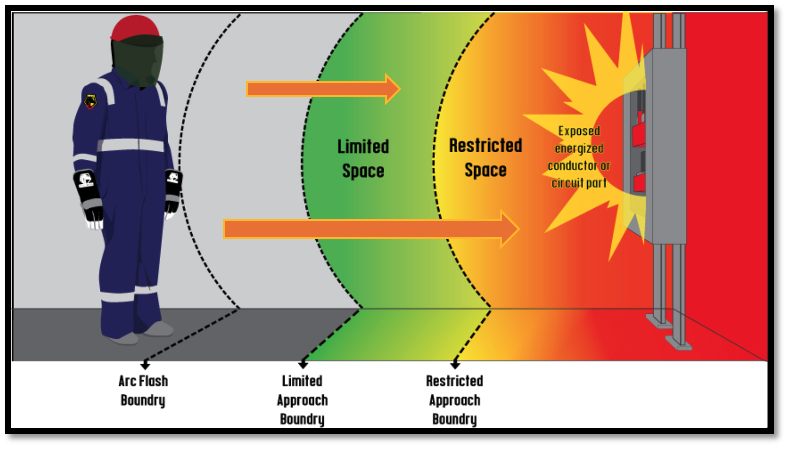
1. Flash Protection Boundary (Outer Boundary)
The flash protection boundary is the farthest established boundary from the energy source. If an arc flash occurred, this boundary is where an employee would be exposed to a curable second degree burn (1.2 calories/cm2). When an energized conductor is exposed, you may not approach closer than the flash boundary without wearing appropriate personal protective clothing and personal protective equipment.
2. Limited Approach Boundary
The limited approach boundary is the minimum distance from an exposed live component where unqualified personnel may safely stand. No untrained personnel may approach energized parts any closer in this boundary unless under the supervision of a qualified worker and using proper PPE. A qualified person must use the appropriate PPE and be trained to perform the required work to cross the limited approach boundary and enter the limited space.
3. Restricted Approach Boundary
The restricted approach boundary is the distance from an exposed part which is considered the same as making contact with the live part. Only qualified personnel wearing appropriate personal protective equipment (PPE), having specified training to work on energized conductors or components, and a documented plan justifying the need to perform this work may cross the boundary and enter the Restricted Space. Insulated gloves, tools, and equipment are required within this boundary.
Maintenance of Arc Flash PPE
Flame Resistant Clothing
- Montior the Age of Clothing.
- There are many different FR fabrics in use now, and each has a different lifespan. The general rule of thumb is to own 5 sets of arc flash clothing, with each set being washed and worn once per work week. Used according to these guidelines, treated 100% cotton lasts an average of 12 to 16 months, 88/12 cotton and nylon blends last for 18 to 30 months, and 93% Nomex® blends last anywhere from 2-1/2 to 4 years.
- Manage in accordance with the manufacturer’s instructions.
- Keep Clean.
- Dirt, oil, chemicals and other contaminants can wear down the flame-fighting properties of arc flash pants, shirts, hoods, jackets and coveralls.
- Wash FR Clothing as soon as possible after being soiled.
- Do not re-wear arc flash clothing without laundering – dirty PPE is less effective than clean.
- Use Care when Washing.
- Use mild detergent and warm (not hot) water, and then tumble dry on low.
- Do Not use bleach or any other chlorine-based detergents, because in most cases
- Follow the manufacturers the manufacturer’s instructions regarding washing directions.
- Inspect for Damage.
- Inspect your arc flash apparel for signs of wear and damage prior to use.
- In the event that damage is found, either repair it in accordance with the manufacturer’s specifications (special flame-resistant fabric patches and/or thread may be required), or replace the damaged article of clothing immediately.
- Do Not continue to wear damaged PPE.
Insulated PPE Gloves
- Keep Clean.
- Chemicals, oils, and other petroleum-based products can cause rubber to weaken and break down.
- Wash off with tap water and a mild, bleach-free detergent.
- Thorough (but gentle) drying with a clean cloth.
- Check for Embedded Materials.
- Small, sharp particles of foreign material may work their way into the gloves and go unnoticed, creating small holes and weak points that can compromise performance.
- Before each wearing, roll gloves between your hands to feel for embedded particles. If any are found, gloves must be electrically tested prior to reuse.
- Air Test Before Use
- Hold the gauntlet (sleeve) end of the glove closed, trapping air inside. Tightly roll the closed end downward, toward the fingers. If no air leaks out, the glove is free from holes.
- Electrical Testing
- Gloves are electrically tested twice a year, in accordance with the stamped dates on the gloves.
- If gloves are not used within a year following their electrical test, retest the gloves prior to use.
- Correct Storage.
- Avoid heat, UV rays and pressure from other objects storing gloves.
- Ensure that gloves are clean and dry.
Hard Hats
The guidlines for the use and maintenance of Hard Hats are as follows:
- Use and store in accordance with the Manufacturers requirements.
- Do not sotre hard hats in temperatures above 50 degrees, such as locked cars.
- Do not allow hard ahts to com into contact with chemicals, including paint and possibly some glues or solvent-based adhesives.
- In the event that a hard hat sustains a knock or a drop, replace immediately even if there is no visible damage.
- Replacement Schedule. The Australian Standard (AS 1800:1998) requires that the harness is replaced every two years.
- Inspect for Damage.
- Inspect PPE for signs of wear and damage prior to use.
- In the event that damage is found, replace the damaged PPE immediately.
- Do Not continue to wear damaged PPE.
- Clean after use.
- Do Not clean with harsh chemicals or solvents.
General PPE
The guidlines for the use and maintenance of General PPE are as follows:
- Use and store in accordance with the Manufacturers requirements.
- Store in a clean dry place. Maintain packaging until use if new.
- Inspect for Damage.
- Inspect PPE for signs of wear and damage prior to use.
- In the event that damage is found, replace the damaged PPE immediately.
- Do Not continue to wear damaged PPE.
- Clean after use.
References
| Jurisdiction | Code of Practice | Guidance Material |
|---|---|---|
| New South Wales | Managing Electrical Risks 2019 | Electrical Arc Flash Hazard Management Guide |
| Northern Territory | Managing Electrical Risks in the Workplace 2020 | |
| Queensland | Managing Electrical Risks in the Workplace 2021 | |
| South Australia | Managing Electrical Risks in the Workplace 2020 | |
| Tasmania | Managing Electrical Risks in the Workplace 2018 | |
| Victoria | Electrical Safety for the Work on or near High Voltage Electrical Apparatus 2017 | Arc Flash Hazard Management |
| Western Australia | Persons Working on or near Energised Electrical Installations 2017 | Safety Management of Electrical Arc Flash Hazards |
Australian Institute of Health & Safety Body of Knowledge Electricity Appendix Arc Flash