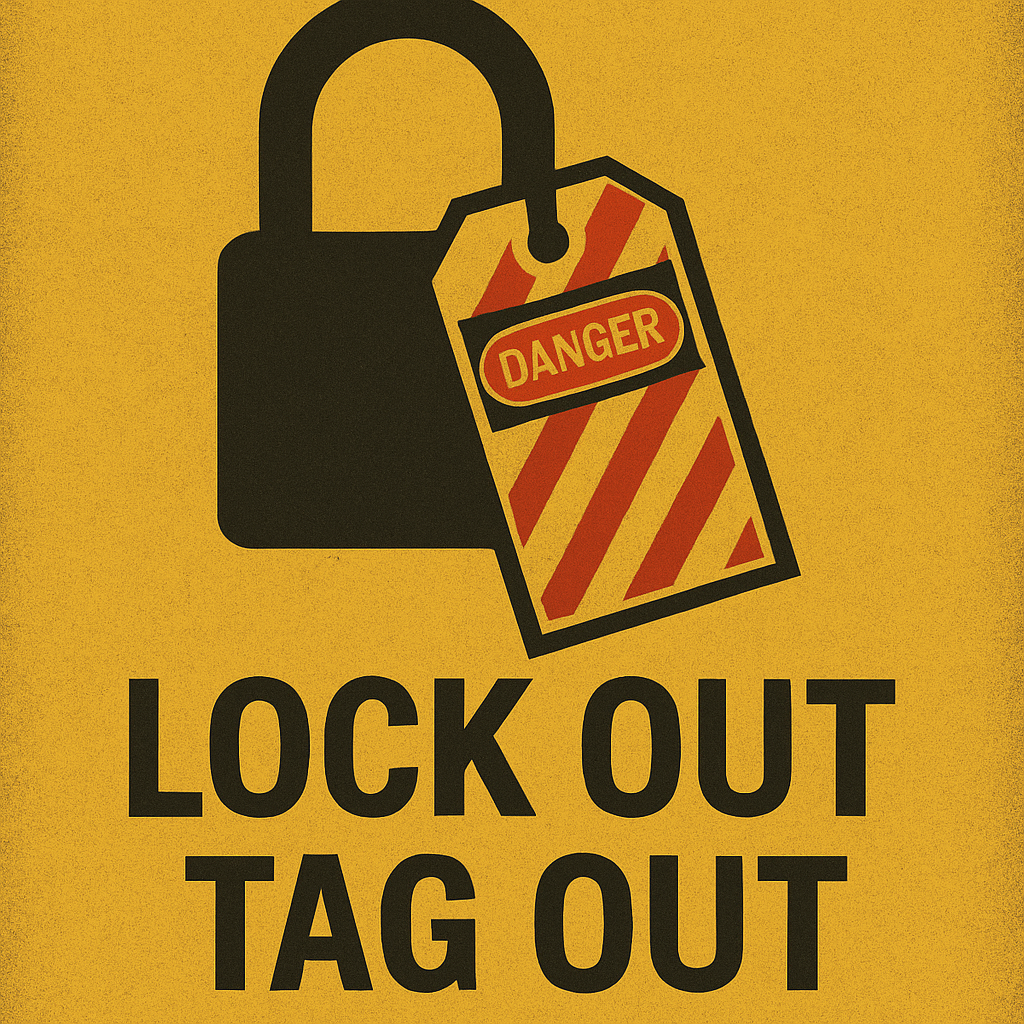
Purpose
The purpose of this document is to eliminate or minimise the risk of injury when working on plant or equipment that has the potential to be energized or under pressure, so far as is reasonably practicable.
Isolation Principles
- All isolation points must be capable of being locked and tagged and there must be no duplicate key for any lock.
- Locks are to be not used for any other purpose other than their designated purpose (i.e. Equipment Locks to isolate equipment and Personal Locks for individuals working on plant).
- Isolation is required where there is removal of guards, protective shields or dismantling of equipment components, where the restoration of energy may expose personnel working on the equipment to risk.
- Control circuit devices such as push buttons, selector switches, limit switches, interlocks or similar devices cannot be used for isolation.
Work Practices
- Do not perform work on energised (live) equipment or parts. Systems and equipment must be de-energised and isolation points secure (locked and tagged) before work is performed on them.
- Each exposed part must be treated as energised until it is isolated and verified not to be energised; and for high-voltage work, each exposed part is to be earthed after being de-energised.
- Damaged or faulty electrical equipment, tools, appliances or installations must be taken out of service immediately and an ‘Out of Service’ tag applied to the energy source and reported to the Workplace Manager.
- The tag/lock must only be removed with your own tag/lock. Never remove or destroy another person’s Lock/Tag or an Equipment Lock/Tag unless approved in writing by the appropriate Authorised Isolator.
- No vehicle, machine, equipment or process is to be operated when any tag or lock (Personal, Isolation, Out of Service) is attached.
- Tags and their method of attachment must be made of materials which can withstand the environmental conditions of the workplace.
Isolation Steps
Identify Required PPE and Equipment
Prior to any work on electrical or pressurised equipment determine through the risk assessment and the JSEA/SWMS review process the minimum required PPE and detection equipment required for the task (consult the relevant standards).
Consider the following:
- Rescue provisions (LV rescue kits);
- Standby personnel;
- Arc flash;
- Type of testing equipment
Identify All Energy Sources
- Identify potential sources of energy supplying or within the plant or equipment. The energy supply may have more than one source and supply line and there may be more than one energy source (e.g. electricity as well as moving mechanical parts).
- Associated plant may also need to be locked out to prevent inadvertent activation.
- When High Voltage or radiation sources are involved an appropriately competent specialist is required to ensure compliance with legislative requirements.
- Complete an Isolation Permit detailing the work to be done and the isolations required.
- Identify All Energy Sources
- Make sure it is safe to isolate the equipment.
- Shut Down Equipment
• Use normal stop processes to shut down equipment.
• Turn off and De-energise Each Isolation Point.
• Emergency stop buttons, pull (stop) lanyards or similar stop devices are not to be used for isolation.
• Associated plant may also need to be locked out to prevent inadvertent activation or valves on pipes and lines supplying gases or fluids under pressure may need to be locked shut or blanked off.
• Valves on pipes and lines supplying gases or fluids under pressure must be blanked off and locked. - Where a single isolation point:
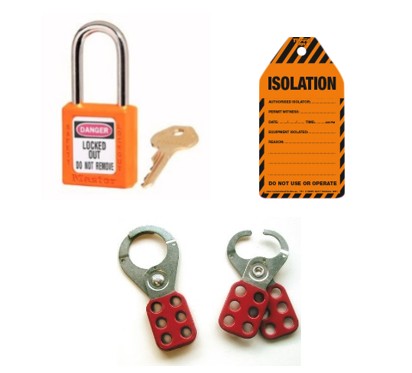
• Attach the Equipment Lock and Isolation Tag to the isolation point with a scissor hasp to allow Personal Locks to be attached.
• Complete information required on the Isolation Tag.
• Note the isolation on the Permit.
• The Authorised Isolator must personally retain the final Equipment Lock key. - Where more than one isolation point:
• Progressively secure each isolation point by attaching an Equipment Lock and Isolation Tag, completing information required on the Isolation Tag.
• Note each isolation on the Permit.
• If third party isolator is required, then the Authorised Isolator is responsible to ensure a suitably qualified person notes this on the permit on completion of that isolation (point).
• Place the Equipment Lock key/s into a Lock Box which is then locked with a Permit Lock on a scissor hasp.
• The Authorised Isolator personally retains the final Permit Lock key.
- operate stop / start buttons, circuit breakers in both local and remote mode.
- Inspect the machinery and equipment to make sure all parts have stopped moving.
- release the tension on springs or block the movement of spring-loaded parts.
- test the circuit again to see that it is dead; then test a known live source again to ensure the meter is still working
- air, gas, steam, hydraulic fluid etc. systems, check pressure – test and inspect remaining pressure in piping, accumulators and cylinders. Bleed off or disconnect piping. Operate enough combinations of controls to verify zero stored energy.
- pressure lines – break or lock open vent points between two chained & isolated valves
- valves / levers – attempt to operate in both manual and remote modes.
- Place Isolation Permit, JSEA/SWMS in a weatherproof document holder. Attach to the lock box if used.
- Before starting work on the equipment each individual places their own Personal Locks and Personal Danger Tags on the scissor hasp. The person whose name is on the Personal Danger Tag is the only one permitted to work under its protection. If more than one person is involved in the work each must attach their own Personal Lock and Personal Danger Tag.
- For single isolation points on the scissor hasp with the single Equipment Lock
- Where multiple isolation points) on to the scissor hasp on the lock box.
- Remove their own personal locks and tags from the lock box/hasp when:
- the job is complete or has been reassigned and the individual is no longer working on it;
- the end of the shift by the individual; or
- the job is incomplete but the individual leaves the area.
- Ensure work team members have signed off any Permits and removed all Personal Locks and Tags.
- Check the work is complete and the equipment is safe to be returned to service.
- Where a lock box is used unlock with the Permit Key.
- Use the Equipment Lock key/s to remove the Equipment Lock/s and Isolation Tags from the equipment.
- When all locks and tags have been removed, sign off the Isolation Permit.
- Re-energisation and Commissioning
- A planned process must be in place for all energisation and commissioning. The Energisation Commissioning Permit must be used when identified as necessary in the JSEA/SWMS.
Testing and Verifying
Test to verify each isolation is at zero energy state:
Safeguard the Key
The Authorised Isolator personally retains the final Equipment Lock key or Permit Lock key.